
B.Sc. in Forestry
Program Profile
Occupational profiles of graduates
We offer diverse areas of studies to enable student to have careers in public and private sectors, which include:
• Ministry of Agriculture / forestry
• Forse of environment conservation
• Directorate of environment
• High department education
• Research institutes • Workshop in forest sciences
Qualification awarded
Bachelor of Science in Forestry
Length of programme
4 years
Number of credits
240 ECTS credits
Mode of Study
Full time on campus
Read more about the programme
Get detailed information about the programme requirements, courses, credits, and educational objectives as a PDF file.
Program Educational Objectives (PEOs)
1- The department of forestry provides well qualified professionals in the field of forestry. It furnishes students with the necessary education to face forestry problems in Kurdistan region and to make sound decisions concerning conservation of forest resources and assurance of the sustainable yield of market and non-market goods and services.
2- The department strongly focuses on how to establish sustainable forest plantations, protection, care of woodland and natural forests.
3- In this department we are trying to provide high quality education and research programs to enable students to analyze issues of Silviculture and Forest Ecology. To understand the essentials of Agroforestry, Urban forestry and Conservation of Forest Resources. We also prepare students to be able to deal with the issues of Forest Management and Economics, and to know how to utilize the forest and manufacture wood products.
4- The department of forestry implements its goals and objectives through a well-balanced integration between education, research, and outreach activities. Generally, the curriculum has been developed to revolve around several areas of interest.
Program Learning Outcomes
- Demonstrate a comprehensive understanding of forest and rangeland ecosystems, including their establishment, growth, composition, conservation, and management across various forest types. Apply effective management and restoration strategies to sustain forests, rangelands, and wildlife health, particularly under environmental stress conditions.
- Produce high-quality seedlings — using nursery techniques, propagation methods, and breeding techniques for afforestation and reforestation.
- Manage urban including tree species selection, planting, infrastructure, risk assessment, and community engagement.
- Analyze wood using physical, chemical, anatomical, and mechanical methods (microscopy and macroscopy), and develop the best forest harvesting plans to maximize timber benefits through wood industry principles.
- Identify and manage insect pests and diseases — through diversity monitoring, diagnosis, and preventive measures.
- Apply conservation and soil properties principles — protecting forest resources, controlling soil erosion, and maintaining soil and ecosystem health.
- Design and analyze experiments — using research methodology, statistical tools, and regression models to interpret forestry data.
- Use GIS and remote sensing tools—including ERDAS IMAGINE and ArcGIS—to perform spatial analysis and support effective land use planning.
- The ability of plant identification and classification to understand the diversity, species relationships and their role in forest managing and conservation.
- Apply agroforestry and sustainable land use practices — integrating trees and crops, and managing grazing systems.
- Understand genetics and breeding — including selecting parent trees, managing genetic variation, and applying controlled breeding methods.
- Develop professional and critical thinking skills — solving forestry problems, conducting cost-benefit analysis, and leading research projects.
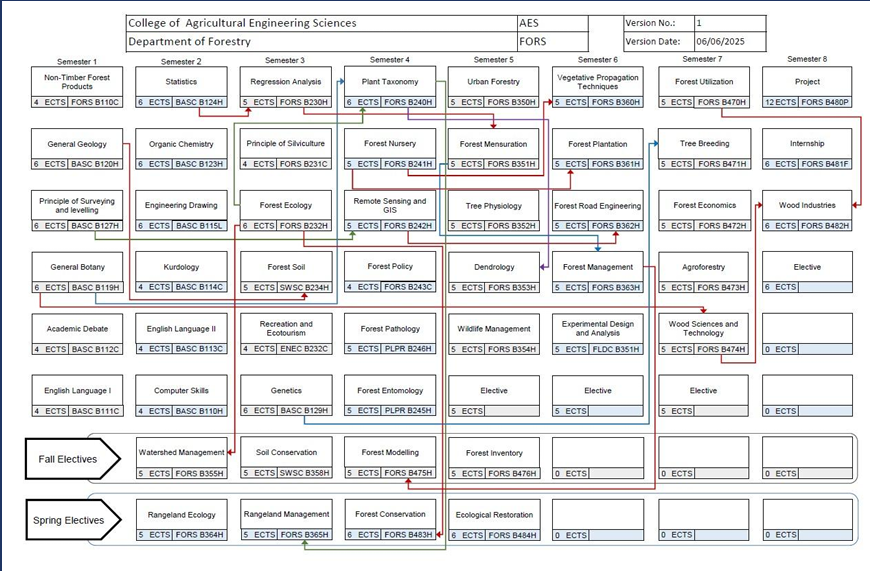
Programme structure diagram with credits
Yearly Timeline
Sept. 1, 2026
⚠️ First year students start around mid-October
⚠️ First year students start exams around 20 of January
July 1, 2027
Check out the full academic calendar on UoD's webstie.
Programme Coordinator

Forestry
College of Agricultural Engineering Sciences
University of Duhok
Apply to the Programme
Public undergraduate admissions in the KRG region are managed centrally by the Ministry of Higher Education through the online ZankoLine portal (regayzanko.com). After Grade 12 Baccalaureate results are released, high schools provide students with unique login credentials to rank their preferred universities and B.Sc. majors during a 10–14 day registration window. Final placement is automatically determined by the student's Grade 12 average, subject choices, and department capacity.